_edited.png)
Why Your Airbnb Is Making Less Money Than Your Neighbour's

Let's start with a number that might sting a little.
A property on the Gold Coast. Palm Beach. Three bedrooms. Same suburb as six comparable properties listed on Airbnb at the same time, targeting the same guests, on the same platform.
The average weekly rate across those six properties: $2,431.
Our client's property after Haus of Gray completed the fitout: $3,473.75.
That's $1,042 more. Every single week. $54,223 more per year. From the same suburb, the same bedroom count, the same patch of Queensland coastline.
Same neighbour. Different result.
So what's actually going on?
The uncomfortable truth about Airbnb performance
Most Airbnb owners believe their nightly rate is determined by two things: location and luck.
Location matters. We're not going to pretend it doesn't. But here's what the data actually shows: within the same suburb, on the same street, properties with identical bedroom counts can be charging $200 more per night than the one next door — and booking out months in advance while the cheaper listing sits half-empty.
The difference isn't location. It's not luck.
It's how the property looks. How it feels. And whether it was designed for a specific type of guest or just furnished so it's livable.
Your neighbour probably didn't do this on purpose
Here's the thing we see constantly: the property owners making the most money from Airbnb aren't necessarily smarter or luckier than the ones making less. They just made better decisions — usually without fully understanding why — about how their property looks and who it's designed for.
Meanwhile, the underperforming listing next door has a sofa that's slightly the wrong scale for the room, photography that was shot on a phone at 1 pm when the light was flat, a listing description that reads like a real estate advertisement, and a nightly rate set by looking at competitors rather than understanding what makes the property worth more than them.
None of these feel like big decisions when you're making them. Collectively, they're costing you $54,000 a year.

The five gaps that separate a high-performing Airbnb from an average one
Gap 1 — The photography gap
Guests make booking decisions based on a thumbnail. One image. Roughly two seconds of attention before they scroll to the next listing or click through to yours.
If your hero shot — the first image guests see — doesn't immediately make someone feel something, they're gone. Not because your property isn't good. Because the photo didn't earn the click.
Professional photography increases bookings by up to 40% according to Airbnb's own data. But "professional" alone isn't enough. The photos need to be styled for the camera, which is a different skill to styling for living. The angle, the light, the objects on the coffee table, the height of the artwork on the wall — all of it changes between a photo that converts and one that doesn't.
We know this specifically because Joe — our co-founder — is a professional real estate photographer who has shot hundreds of properties across Brisbane and Southeast Queensland. He shoots our Airbnb fitouts after styling because the combination of the right styling and the right photography is what actually moves the needle on booking rate.
Your neighbour's property might be identical to yours in size and location. But if their photos make someone feel like they want to be there, and yours just show what's in the room, they win every time.

Gap 2 — The guest persona gap
Ask most Airbnb owners who their ideal guest is, and they'll say something like "couples or small groups, anyone really." Which means they've designed the property for nobody in particular.
The properties that consistently outperform their suburb were designed for someone specific. A guest persona. The weekend escape couple who will pay $150 more per night for a bathroom with a freestanding bath and a coffee machine that isn't embarrassing. The business traveller who needs fast WiFi and a proper desk and will book you on repeat because you got those things right. The family who chose Airbnb specifically for the kitchen and the outdoor space, and will leave you a glowing review if the dishwasher actually works.
When you design for one specific guest, every decision becomes easier — the furniture, the amenities, the photography style, the listing copy, the nightly rate. And the guests who find you feel like the property was made for them. Because it was.
The Palm Beach property we mentioned at the start? We designed it specifically for the experience-seeking couple. Every decision — the sofa, the outdoor setting, the photography, the listing copy — was made in service of that guest. The $1,042 per week premium isn't random. It's the financial result of every one of those decisions compounding.
Gap 3 — The furniture gap
This one hurts to say, but it needs to be said.
Most Airbnb furniture looks like Airbnb furniture. A sofa from Freedom that was on clearance because no one wanted it. A dining table from Temple & Webster, because it was $299 and looked fine in the product photo. A rug that's slightly too small because you didnt see value in a more expensive, larger one. Artwork that came in a set of three and was chosen because it was inoffensive.
The result is a space that looks fine in person and worse in photos. And "fine" does not book out months in advance.
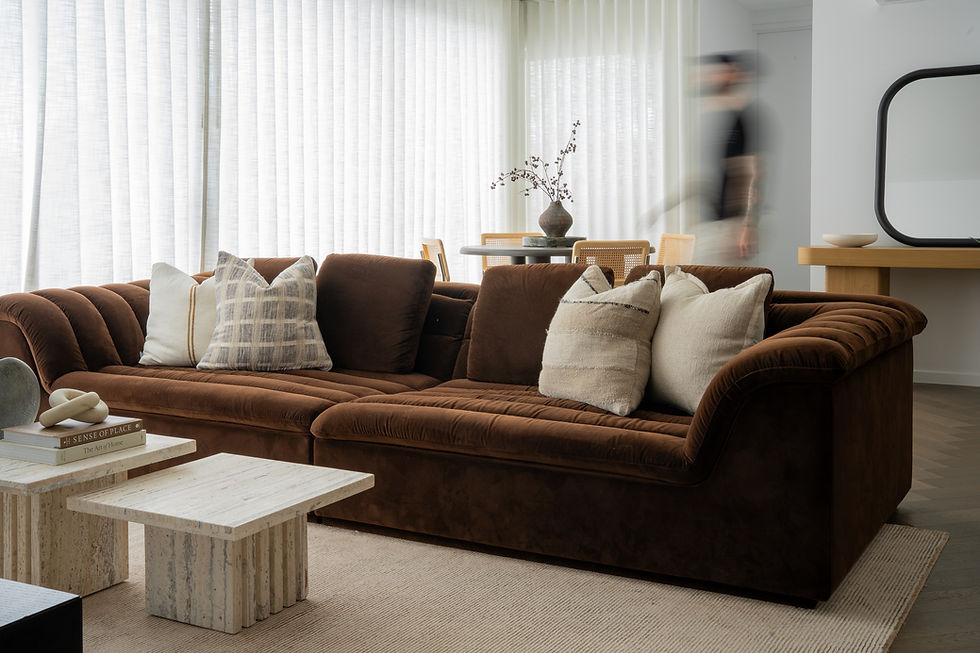
The properties that achieve premium rates have furniture that was chosen for that specific space. The right scale. The right texture. The right relationship between pieces. This isn't about spending more money, it's about spending it better. One sofa at $2,500 that fits the room perfectly will outperform two sofas at $1,200 that don't every single time.
Here's the thing nobody in the industry talks about: interior designers access the same furniture at trade pricing, typically 15 to 30 percent below what you'd pay walking into the same showroom.
On a full Airbnb fitout, that's a meaningful saving. Our clients consistently spend less on furniture through us than they would doing it themselves, while getting better pieces, better placed.

Gap 4 — The listing copy gap
Your listing description is doing almost no work.
We know this because most Airbnb descriptions read identically. "Beautiful 2-bedroom apartment in the heart of [insert your chosen suburb]. Walking distance to restaurants and cafes. Fully equipped kitchen. Free WiFi. Perfect for couples or small groups."
This tells a guest nothing that differentiates your property from the seventeen others in the same suburb. It doesn't make them feel anything. It doesn't give them a reason to choose you over the listing above or below yours.
Compare that to an opening paragraph that actually sells the feeling:
"You walk in, and something shifts. The light comes through the floor-to-ceiling windows and hits the marble coffee table, and you remember what it feels like to actually switch off. That's what this place is for."
Same property. Different words. Different conversion rate. Different nightly rate you can justify.
Gap 5 — The pricing strategy gap
Most Airbnb hosts set a rate by looking at competitors and pricing slightly below them. Which means they're competing on price rather than value, and that race only goes one direction.
The properties that consistently charge above market aren't discounting to fill the calendar. They're priced confidently at a premium because the property earns it, and they use dynamic pricing tools like PriceLabs or Beyond Pricing to adjust rates based on demand, local events, and seasonality rather than guessing.
A property that achieves 75% occupancy at a rate 20% above market generates more revenue than a property at 95% occupancy at market rate. More money. Less wear on the property. Better quality guests. Better reviews.
But you can only price with confidence above market if the property actually justifies it. Which brings us back to gaps 1 through 4.

The reason your neighbour is making more money
It's probably not that they got lucky with their suburb. It's probably not that they have more bedrooms or a better view.
It's that at some point — accidentally or deliberately — they made decisions that compound. Better photos. Furniture that photographs well. A listing that makes someone feel something. A rate that reflects what the property is actually worth rather than what the competition is charging.
Those decisions don't feel significant individually. Collectively, they add up to $54,000 a year.
What to do about it?
Start with the photography. If your current listing photos were taken on a phone or by a photographer who didn't style the space before shooting, that's your highest-leverage fix. New photos alone can move your booking rate meaningfully.
Then look at your furniture critically. Not whether you like it, but rather whether it photographs well, whether it fits the room properly, and whether it communicates the right feeling for the guest you're trying to attract.
Then rewrite your listing description. Lead with the feeling, not the features.
If you want help with any of this, we offer a FREE 30-minute consultation where we look at your specific property and go through exactly how we can boost your numbers. No obligation call.
Because $54,000 a year is a lot to leave on the table.
Email us at studio@hausofgray.com.au or by clicking the button below.

